List of interview questions – extracts
You mentioned that art has always been a part of your life. How did the influence of your grandfather and great-grandfather shape your approach to art?
They were both major artists painting from clothes design to architectural pieces for private gardens and palaces, like gardens’ gazebos. My grandfather also designed gardens and parts of some palaces in Portugal Lisbon. My father who is very proud of such art works has always hanged some of their best works in our house, so I’ve been surrounded by them since I was born. And following a recent trial of using stencils, my father gave me my grandfather’s brushes since he also designed stencils. I feel very blessed to have them and to be using them now.
They mainly used watercolours which is probably why I so much like this media too. Their use of watercolours was very soft, as opposed to mine which is more colourful, but they remain a great inspiration. They also taught me to look closely and study others’ works of art, and that right from an early age. Hence my decision to study two hears of History of Art in 1992.
Finally, their love for art was not just about creating—it was about observing the world with curiosity and finding beauty in everyday moments. This perspective stays with me to this day, influencing the way I approach each piece, whether through colour, texture, or composition. Their legacy instilled in me a deep appreciation for both tradition and innovation, allowing me to develop my own artistic voice while staying connected to the past.
You have a rich educational background in both fine arts and visual culture. How did these experiences inform your art practice and understanding of visual works?
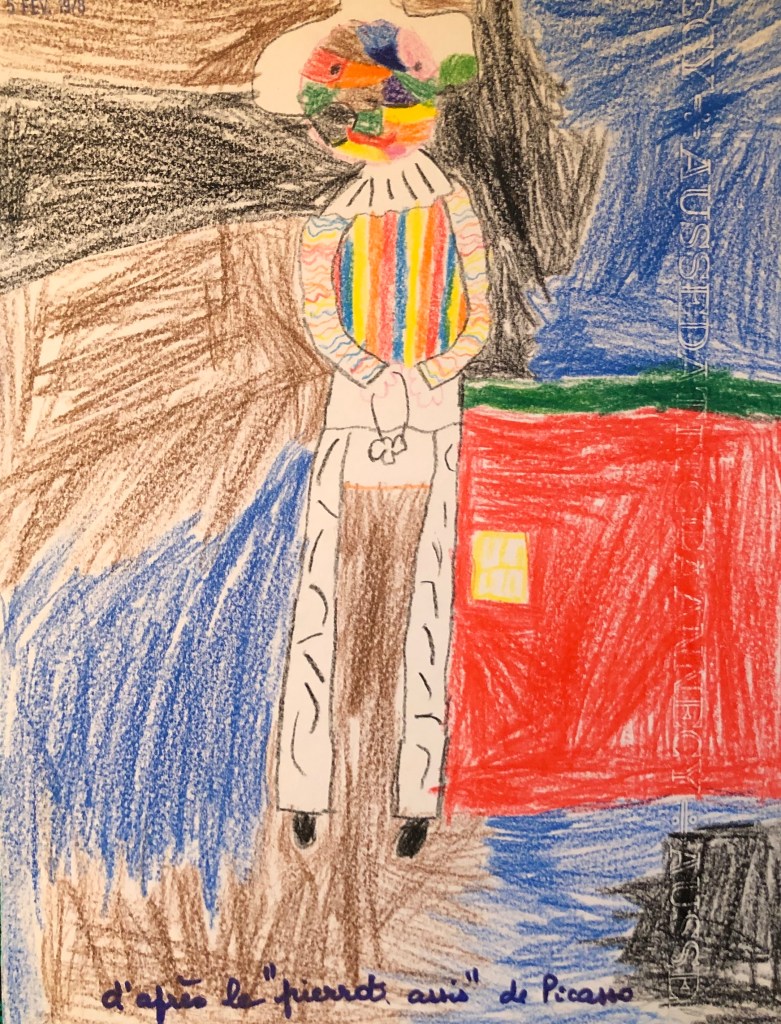
Indeed, I’ve been in fine art since an early age see my Picasso at primary school!
I took private lessons during high school and chose a fine art baccalaureate. Then I entered the first year of the famous ENSAG Graphic Art School in Paris where I learnt with a profond investment all sorts of techniques out of which my favourite ones were painting from plaster busts but also nudes, especially when in movement. I then turned to theory which is essential for me in order to progress in my art practice, by research and analyses of other major painters. So, I did a two year university course in History of Art of which I especially remember the subject of Indian Art History which later on inspired me to travel to India and Nepal on a trip following the route of Buddha and discovering all the art and craftwork around his religious journey.
Finally, I ended my education with a Bachelor of Art in Visual Culture in Falmouth UK… being bilingual from birth (my mother is English) made it easy to study this course and I graduated with a first a first-class degree and as a the major of my promotion. There I studied a lot of philosophy, reading Foucault a lot, but also Bakhtin and Levi-Strauss and finally a group of feminist scholars, including Cixous, Irigaray and Kristeva. My major dissertation was titled THE DIALOGICAL DISCOURSES OF THE ABJECT: THE USES AND MEANS OF THE ABJECT IN WESTERN FEMININE FINE ART PRACTICES. I loved exploring these women’s art works and trying to understand their practice, as well as my place as a woman in a patriarchal society. In this dissertation I insisted on the use of the body in art… which later influenced me on my nudes but also for my women’s portraits. Artists I studied included: Cindy Sherman, Helen Chadwick, Laura Godfrey-Isaacs but also Gilbert and George.This education has widened my own practice and how to understand major artists’ works. It has also motivated me to travel and go and visit museums across the world. I recently visited the permanent collection of Beaubourg centre in Paris (that was easy I live near Paris!) and was overwhelmed and inspired by the artists who worked as of 1905 till 1990. In the past, I have been to Barcelona, Venice twice for the Biennale, Madrid, New York, Prague, Berlin, Amsterdam but also in a different style to Giverny’s gardens, I also travel to London at least once a year always paying a visit to the Tate Modern… the list is rather long!
– After a break from oil painting, you’ve made a remarkable return in 2024. What inspired you to go back to oil painting, and how has your approach evolved?
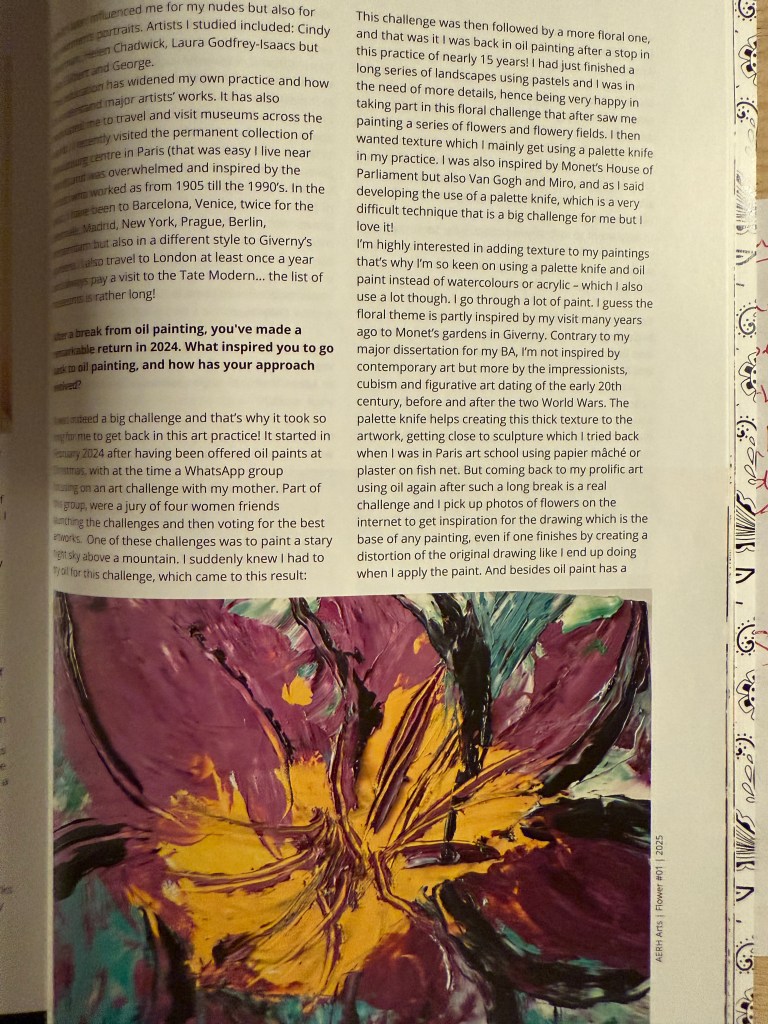
It was indeed a big challenge and that’s why it took so long for me to get back in this art practice! It started in February 2024 after having been offered oil paints at Christmas, with at the time a WhatsApp group challenging my mother with a jury of four women friends giving us challenges and then voting for the best art works, and one of the challenges was to paint a stary night sky above a mountain. I suddenly knew I had to try oil for this particular challenge, which came to this result:
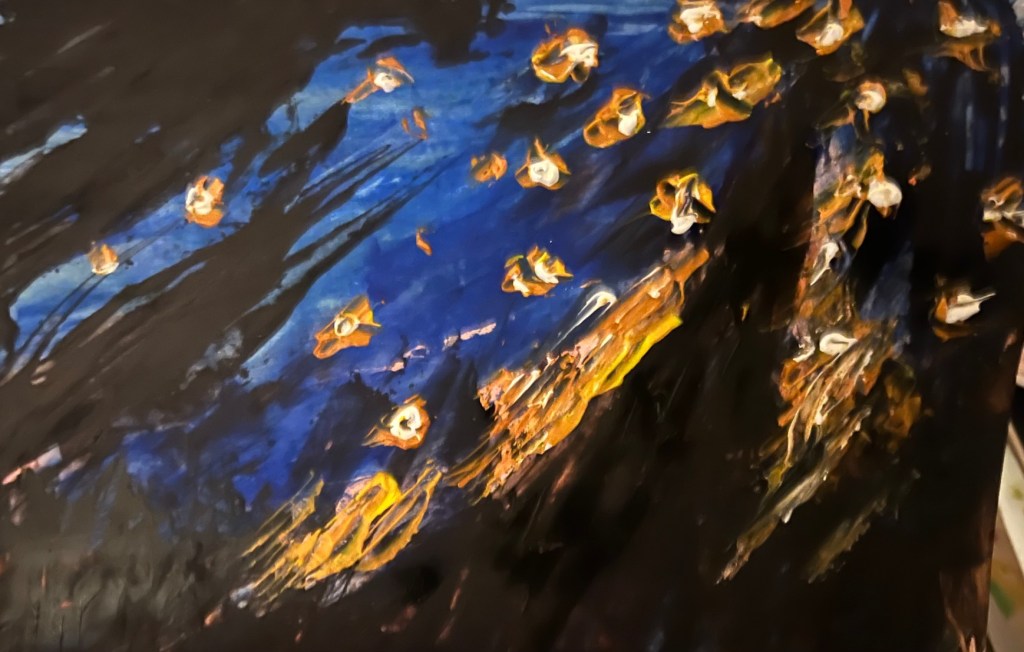
This challenge was then followed by a more floral one, and that was it I was back in oil painting after a stop in this practice of nearly 15 years! I had just finished a long series of landscapes using pastels and I was in the need of more details, hence choosing to paint flowers and flowery fields. I wanted texture which I mainly get using a palette knife in my practice. I was also inspired by Monet’s House of Parliament or Van Gogh and Miro, and as I said developing the use of a palette knife, which is a very difficult technique that is a big challenge for me and I love it!
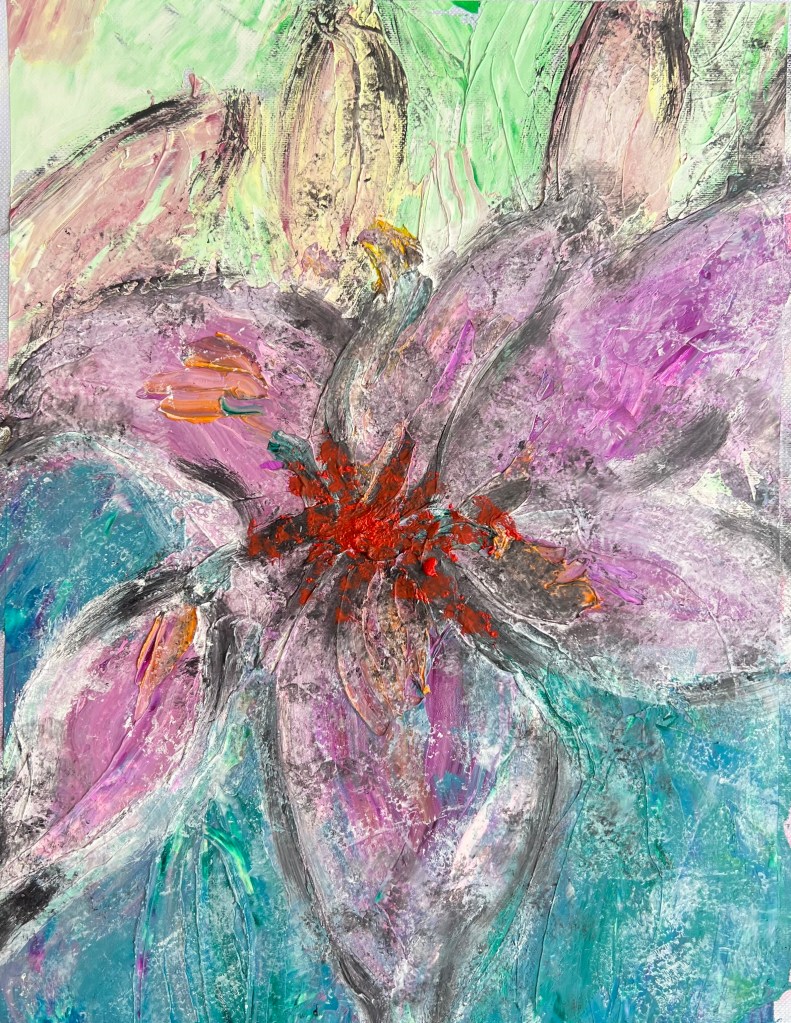
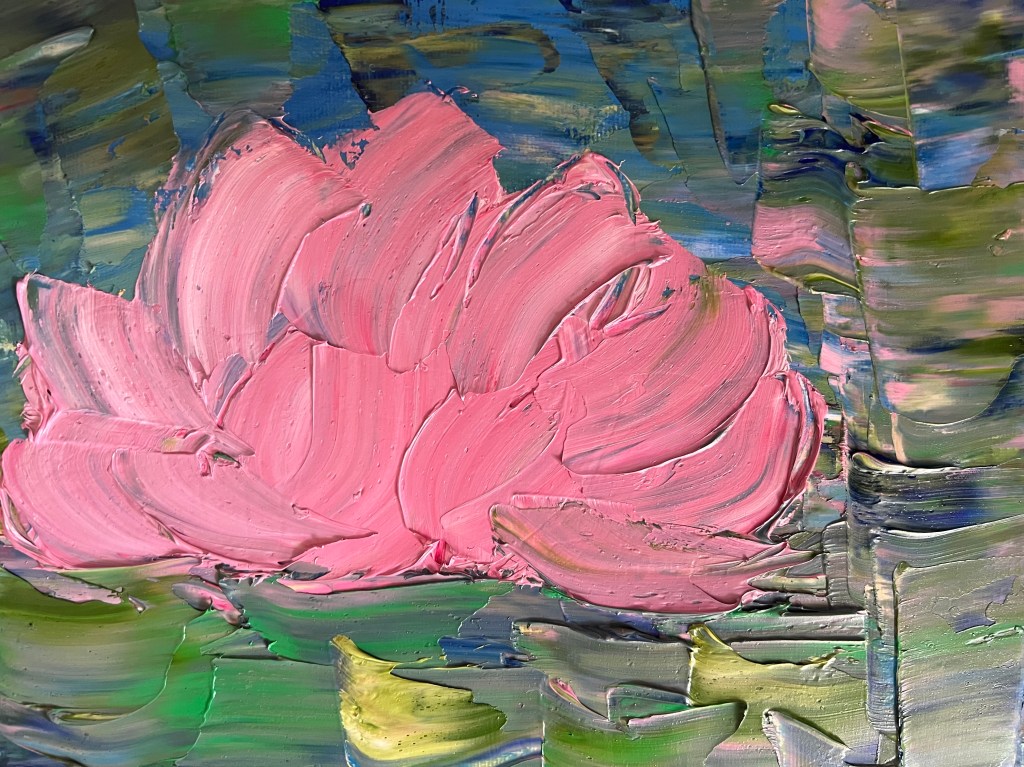
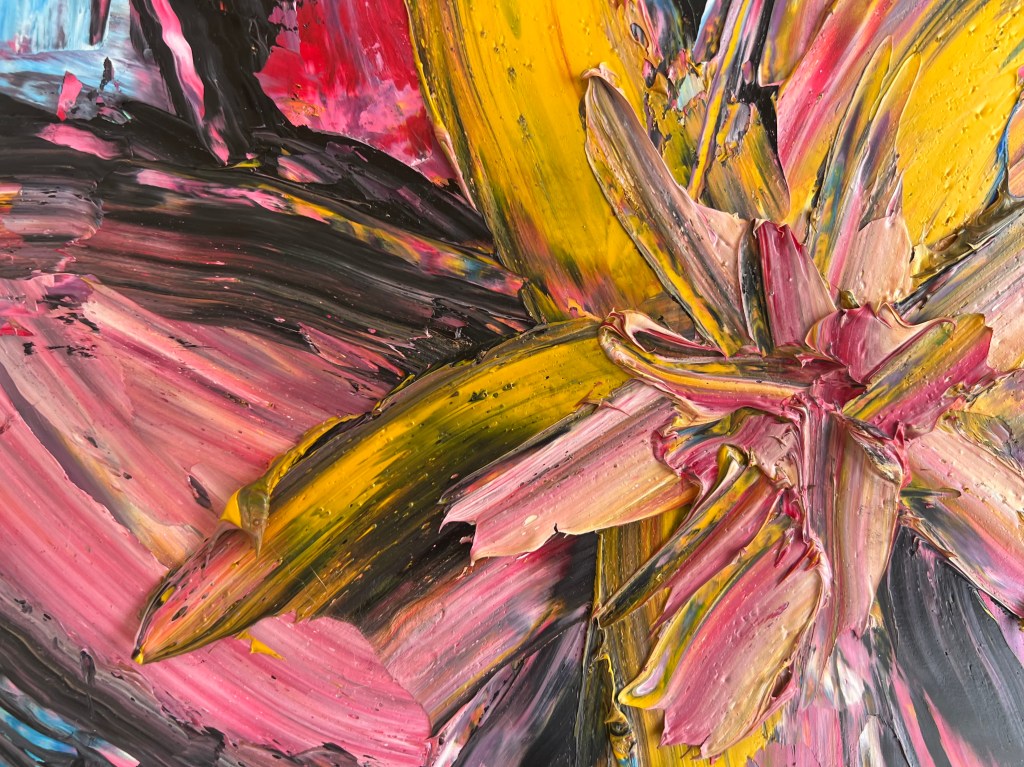
I’m highly interested in adding texture to my paintings that’s why I’m so keen on using a palette knife and oil paint instead of watercolours or acrylic – which I also use a lot though. I go through a lot of paint. I guess the floral theme is partly inspired by my visit many years ago to Monet gardens in Giverny. Contrary to my major dissertation for my BA, I’m not inspired by contemporary art but more by the impressionists, cubism and figurative art dating of the early 20th century, before and after the two World Wars. The palette knife helps creating this thick texture to the artwork, getting close to sculpture which I tried back when I was in Paris art school using papier mâché or plaster on fish net. But coming back to my prolific art using oil again after such a break is a real challenge and I pick up photos of flowers on the internet for inspiration in the drawing which is the base of any painting even if one finishes by creating a distortion of the original drawing like I end up doing when I apply the paint. And besides oil paint has a smell what with the use of turpentine. I used to love visiting artists’ studios at Paris Ecole des Beaux-Arts on the way to my art school. Smelling spirits and observing. Now I do it on my little workshop at home.
Music is also very important for the movements required to adding the paint to the canvas. It all depends on my mood of the day. I can paint listening to Vivaldi and the next minute to heavy metal music! It changes it all. I mean the outcome of the painting is so different. The only links are the use of colours and adding texture. But my body language will definitely be different. The only difficulty with oil is that you have to be patient to let it dry not like acrylic. So, it may take several days to finish an oil painting hence making several ones at the same time. I now have a record of 50 oil paintings done over the past year.
– You’ve worked with a variety of mediums, including watercolours, pastels, chalk, oil painting, and linocuts. How do you choose which medium to use for a specific theme?
I choose my medium based on the mood, texture sought, and depth I want to convey in each piece. Watercolours allow me to create fluid, dreamlike atmospheres, perfect for ethereal or emotional themes. When I want a richer, velvety softness, I turn to pastels, which bring warmth and the important results in blending the colours with my fingers. Oil painting gives me the ability to build layers and textures as I have already explained, making it ideal for pieces that require depth and bold expression, especially with the use of the palette knife. Linocuts, with their strong contrasts and graphic quality, work well when I want to emphasize form and structure in a more dynamic, expressive way. Each medium has its own unique voice, and I love exploring how different techniques can enhance the story I want to tell…..
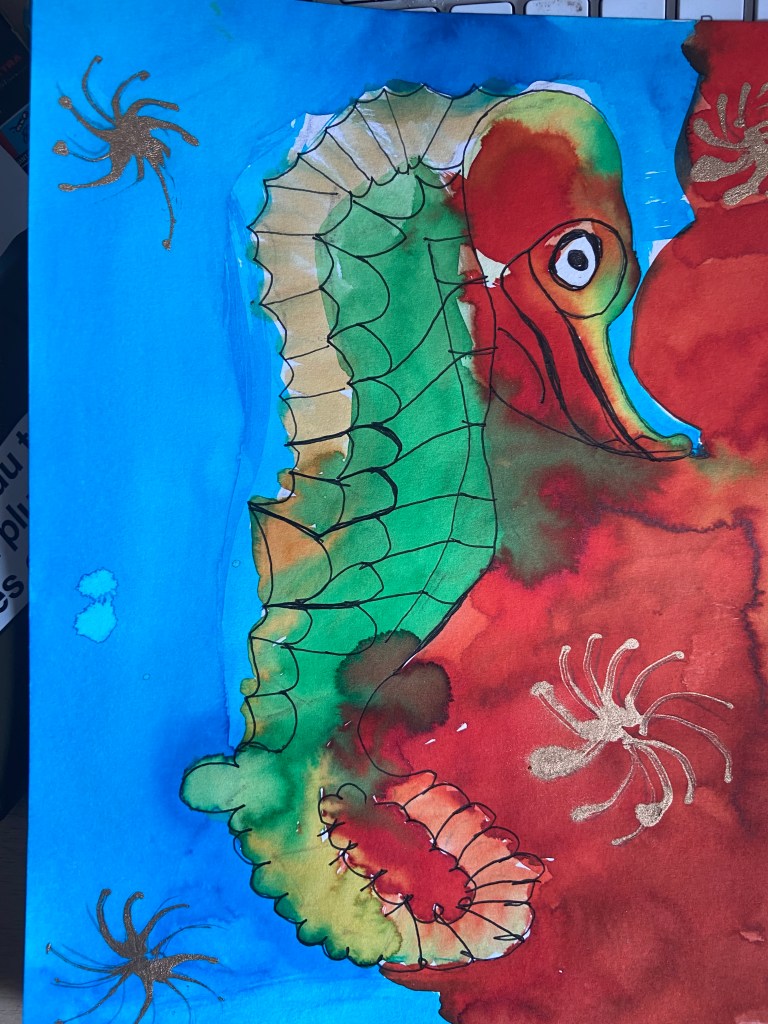
Seahorse, coloured inks
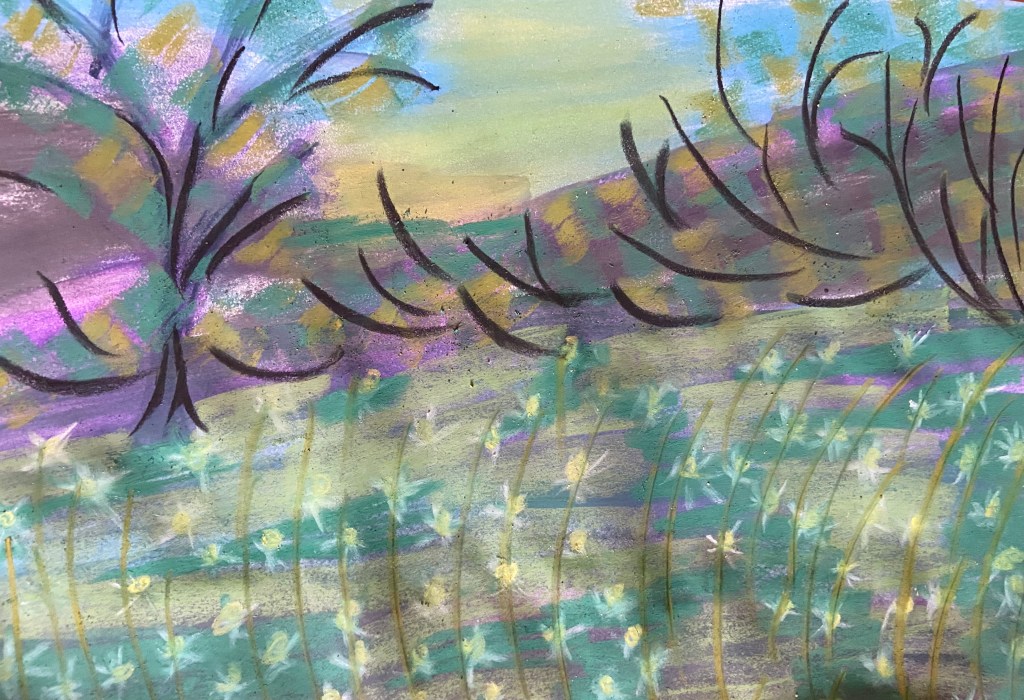
“Promenade #03” Pastels
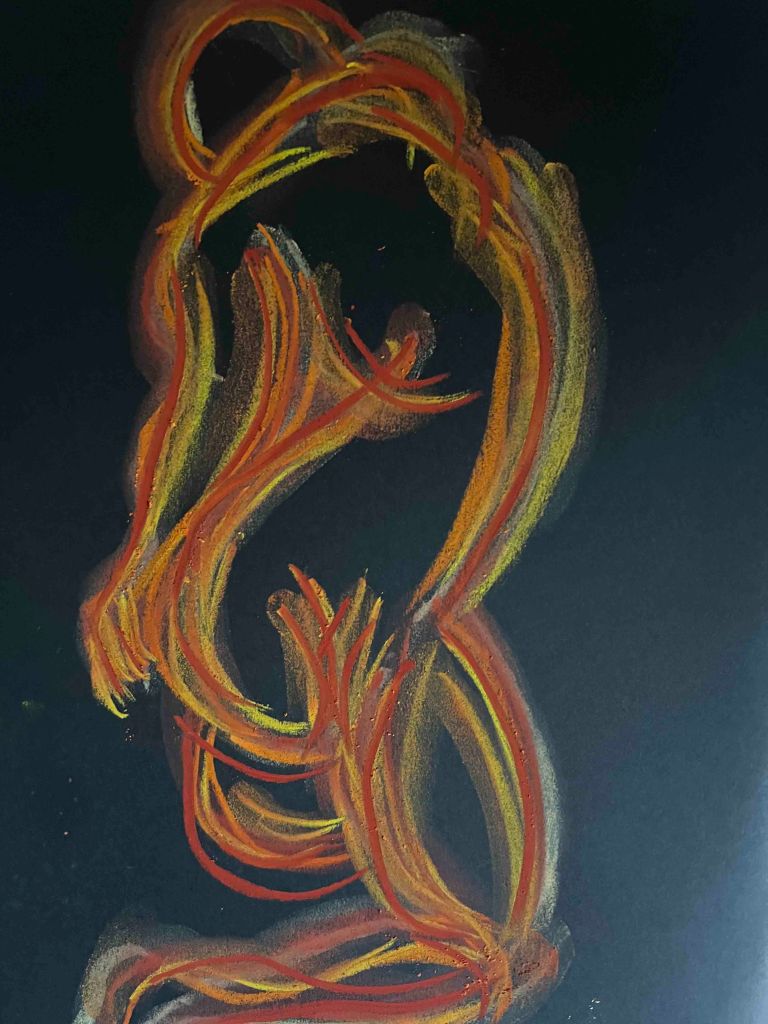
Nude in movement, pastels
I find that each theme or concept naturally calls for a specific medium, and I often feel the need to switch between them to keep my creative process prolific. Some ideas demand the fluidity and unpredictability of watercolours, while others need the rich, tactile quality of pastels or the depth of oil paint. Changing mediums allows me to explore different textures, contrasts, and moods—keeping my work fresh and allowing me to push boundaries. Each medium offers a new way to interpret an idea, and by shifting between them, I ensure that my work remains exciting, both for me and for the viewer.
Roses, Linoprint

 AERH Arts